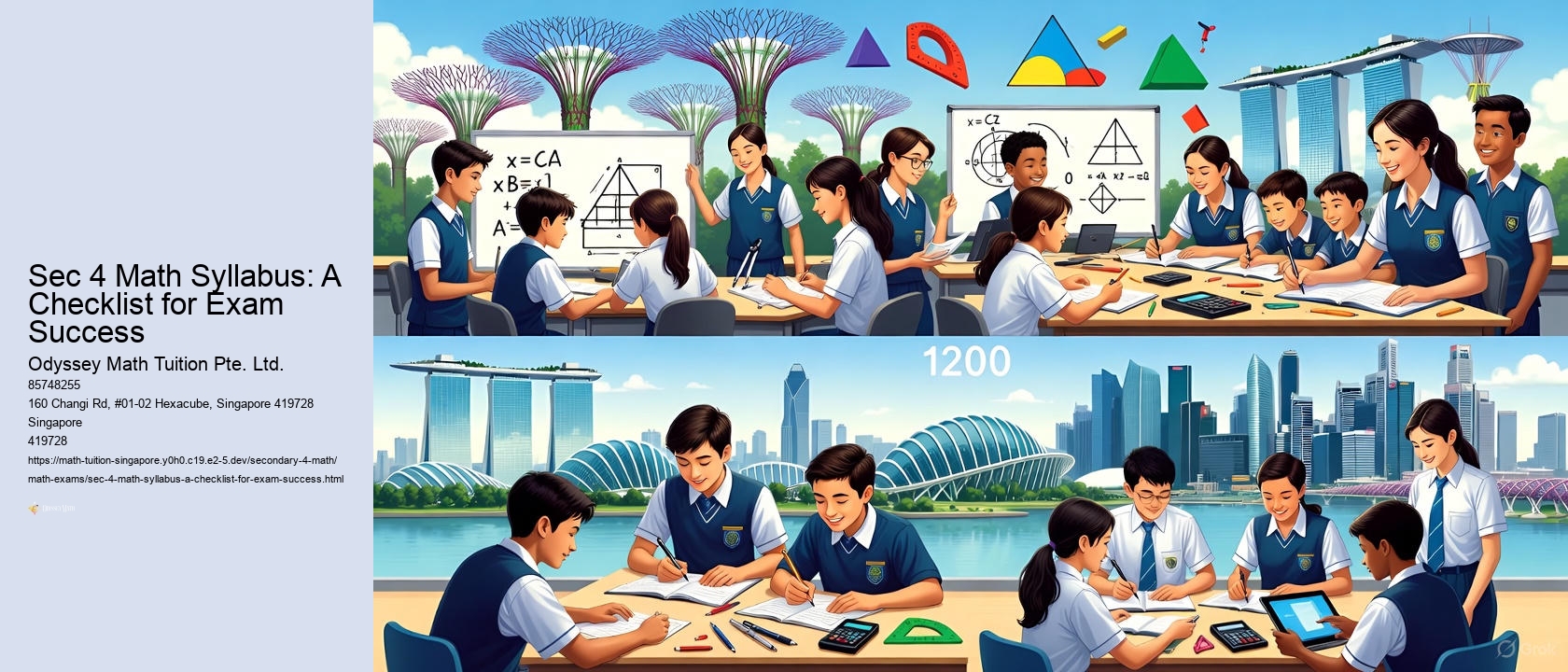
Right, parents, let's talk Sec 4 Math. Your child's future, their future career, could hinge on this. No pressure, lah, but in Singapore, math is king (or queen!). And with AI breathing down our necks, knowing your stuff in math is even more crucial. We're not just talking about acing the O-Levels; we're talking about setting them up for success in a world increasingly driven by algorithms and data. So, chiong ah! Let's get them ready to excel in Singapore Secondary 4 Math!
So, what exactly are they learning in Sec 4 Math? Think of it as building a solid foundation. This isn't just rote memorization; it's about developing critical thinking and problem-solving skills – skills that are valuable no matter what career path they choose. In the city-state's challenging education structure, parents perform a vital function in directing their youngsters through milestone assessments that influence academic trajectories, from the Primary School Leaving Examination (PSLE) which examines basic competencies in subjects like math and STEM fields, to the GCE O-Level tests focusing on intermediate proficiency in diverse fields. As learners advance, the GCE A-Level tests demand advanced logical capabilities and discipline command, commonly influencing higher education entries and occupational trajectories. To keep updated on all elements of these national exams, parents should explore formal materials on Singapore test papers provided by the Singapore Examinations and Assessment Board (SEAB). This guarantees availability to the newest syllabi, examination calendars, sign-up information, and guidelines that align with Ministry of Education requirements. Regularly checking SEAB can aid households plan efficiently, lessen doubts, and support their offspring in achieving peak performance during the demanding environment.. And trust me, hor, even if they think they'll never use algebra again, these skills will come in handy.
The Sec 4 Math syllabus is designed to build upon the concepts learned in lower secondary, introducing more complex topics and requiring a deeper understanding of mathematical principles. Don't play play!
Fun Fact: Did you know that the Singapore math curriculum is consistently ranked among the best in the world? It's not just luck; it's a deliberate focus on conceptual understanding and problem-solving.
The syllabus typically covers these core areas, and it's good to know what's in store for your kid:
The exams aren't just about spitting out formulas. The examiners are looking for:
Interesting Fact: The O-Level Math exam often includes real-world problems, requiring students to apply their mathematical knowledge to practical situations. This tests their ability to think critically and creatively.
The weighting of each topic can vary slightly from year to year, but generally, the core topics like algebra and geometry tend to carry the most weight. It's important to check the latest syllabus document from the Singapore Examinations and Assessment Board (SEAB) for the most up-to-date information. Sec 4 Math: A Revision Checklist for Top Grades . In today's demanding educational scene, many parents in Singapore are looking into effective ways to boost their children's comprehension of mathematical ideas, from basic arithmetic to advanced problem-solving. Creating a strong foundation early on can greatly boost confidence and academic success, helping students conquer school exams and real-world applications with ease. For those exploring options like secondary 4 math it's essential to focus on programs that stress personalized learning and experienced guidance. This method not only addresses individual weaknesses but also cultivates a love for the subject, leading to long-term success in STEM-related fields and beyond.. Confirm plus chop!
History Tidbit: The Singapore education system has evolved significantly over the years, with a constant emphasis on improving the quality of teaching and learning. The focus on mathematics is a reflection of its importance in the modern world.
How to excel in Singapore Secondary 4 Math? It's not about being a math genius; it's about consistent effort, a strategic approach, and the right resources. Mai tu liao Let's get started.
Deepen your knowledge of trigonometric ratios, identities, and their applications in solving problems involving triangles. Explore the concept of vectors, including vector addition, subtraction, and scalar multiplication. Practice applying trigonometry and vectors to solve real-world problems involving angles, distances, and forces.
Develop a strong foundation in geometric concepts, including angles, triangles, quadrilaterals, and circles. Master the use of geometric theorems and properties to solve problems related to area, volume, and surface area. Hone your ability to visualize and analyze geometric figures accurately.
Strengthen your skills in data representation, interpretation, and analysis. Learn to calculate measures of central tendency and dispersion, and understand different types of graphs and charts. Grasp the fundamentals of probability, including calculating probabilities of events and understanding conditional probability.
Alright, parents and Sec 4 students, listen up! Feeling the pressure of those upcoming Math exams? Don't say bo jio! We know the stress is real. In Singapore, acing your Secondary 4 Math isn't just about getting good grades; it's about opening doors to your dream Junior College, Polytechnic and ultimately, a successful future. And let's be honest, with AI taking over the world, a strong foundation in mathematics is more crucial than ever. You want your child to be designing the AI, not replaced by it, right?
This isn't just another tuition ad. We're here to give you the real deal – a checklist, a roadmap, a kiasu guide (because, let's face it, we all are a little bit kiasu when it comes to our kids' futures!) to help you conquer that Sec 4 Math syllabus. This is about how to excel in Singapore Secondary 4 Math, and we're going to break it down for you.
The Sec 4 Math syllabus is like a giant plate of nasi lemak – lots of different components that need to come together perfectly. It's not just about memorizing formulas; it's about understanding the underlying concepts and applying them to solve problems. Think of it as building a house. You need a strong foundation (algebra), solid walls (geometry), and a well-designed roof (trigonometry) to withstand the test of time (and those killer exam questions!).
Interesting Fact: Did you know that the modern mathematical notation we use today, like the equals sign (=), wasn't standardized until the 16th and 17th centuries? Imagine doing algebra without the equals sign! Siao liao!
Algebra is the bread and butter of Sec 4 Math. Master it, and you're halfway there! Here's what you need to nail:
Geometry is where you put on your detective hat and use your visual skills. Here's what to focus on:
Fun Fact: The word "geometry" comes from the ancient Greek words "geo" (earth) and "metron" (measurement). It literally means "earth measurement"! So, next time you're struggling with geometry, remember you're basically an ancient land surveyor!
Trigonometry can seem daunting, but it's all about mastering the ratios and applying them correctly. Here's your checklist:
Okay, now for the good stuff – the actionable tips that will actually help you improve your grades. These are the secrets to how to excel in Singapore Secondary 4 Math that tuition centers kena charge you a fortune for!
History Lesson: The concept of zero wasn't always around! It took centuries for mathematicians to accept zero as a number and use it in calculations. Imagine doing math without zero! Can liao!
So, there you have it – your ultimate guide to mastering the Sec 4 Math syllabus. Remember, it's not about being a math genius; it's about hard work, dedication, and a little bit of Singaporean kiasu-ism. Now go out there and ace those exams! Jiayou!
Visual aids are your best friend when tackling tricky Sec 4 Math problems. Think diagrams, graphs, and even mind maps! These tools help you break down complex information into digestible chunks, making it easier to spot patterns and relationships. For example, when dealing with geometry problems, a well-drawn diagram can reveal hidden angles or similar triangles that you might otherwise miss. Don't underestimate the power of a simple sketch to unlock a solution, especially when you are aiming for how to excel in singapore secondary 4 math.
Sometimes, the best way to solve a problem is to start from the end! This "reverse engineering" technique involves working backwards from the desired answer to identify the steps needed to get there. This is particularly useful for proof-based questions or problems with multiple steps. By understanding the final goal, you can strategically plan your approach and avoid getting lost in unnecessary calculations. It’s like planning your route from Changi Airport to Jurong Bird Park – you need to know where you’re going!
Model drawing, a staple in Singaporean primary school math, remains surprisingly effective even in Sec 4. This visual strategy is especially helpful for solving word problems involving ratios, proportions, or simultaneous equations. By representing the given information using bars or blocks, you can clearly visualize the relationships between different quantities. This method simplifies the problem and makes it easier to identify the necessary operations to find the solution, helping your child learn how to excel in singapore secondary 4 math.
Connecting math concepts to real-world applications makes them more relatable and easier to understand. Instead of just memorizing formulas, try to see how they apply to everyday situations. For example, trigonometry can be used to calculate the height of a building, while calculus can be used to optimize the design of a bridge. This approach not only enhances your understanding but also makes learning more engaging and relevant, especially with the rise of AI technologies where mathematical modelling is crucial.
Everyone makes mistakes, even the best math students! But the key is to learn from them. When you get a question wrong, don't just brush it off. Take the time to carefully analyze your errors and identify the underlying cause. Did you misread the question? Did you make a calculation error? Did you misunderstand a concept? In the Lion City's challenging education landscape, where English serves as the primary channel of teaching and assumes a pivotal role in national assessments, parents are enthusiastic to help their children tackle typical obstacles like grammar impacted by Singlish, word deficiencies, and challenges in comprehension or writing writing. Establishing solid foundational skills from primary levels can substantially boost assurance in managing PSLE components such as scenario-based composition and oral interaction, while high school students profit from specific exercises in literary examination and persuasive papers for O-Levels. For those hunting for effective approaches, delving into singapore math tuition agencies provides helpful information into curricula that sync with the MOE syllabus and highlight dynamic learning. This supplementary assistance not only sharpens exam techniques through mock exams and reviews but also promotes home practices like everyday reading along with conversations to cultivate lifelong language mastery and educational excellence.. By understanding your weaknesses, you can focus your efforts on improving those areas and avoid making the same mistakes again. In this bustling city-state's dynamic education landscape, where pupils face considerable demands to excel in mathematics from elementary to higher levels, locating a educational centre that combines knowledge with true zeal can bring a huge impact in fostering a love for the discipline. Passionate educators who extend past mechanical learning to encourage analytical reasoning and problem-solving competencies are scarce, but they are vital for aiding pupils surmount obstacles in topics like algebra, calculus, and statistics. For guardians seeking such dedicated guidance, PSLE math tuition emerge as a beacon of commitment, motivated by teachers who are strongly invested in individual learner's journey. This steadfast dedication turns into customized instructional plans that adapt to unique demands, resulting in improved performance and a enduring fondness for numeracy that extends into prospective scholastic and occupational goals.. This is an important step on how to excel in singapore secondary 4 math.
Alright, parents and Sec 4 students, let's talk about the elephant in the room – the O-Level Math exam. In Singapore, it's not just another test; it's a crucial stepping stone. Confirm plus chop, acing this exam opens doors to better JC options, poly courses, and ultimately, a brighter future. And with AI becoming so prevalent, a solid grasp of mathematics is more important than ever. It's the language of the future, you know!
So, how ah? How to excel in Singapore Secondary 4 Math and ensure your child (or yourself!) isn't just memorizing formulas but truly understanding the concepts? Let's dive into some proven exam-taking techniques and time management strategies that can seriously boost your score.
Think of your exam paper as a battlefield, and these techniques are your weapons. You need to be strategic!
* **Read the Question Carefully (
Like REALLY Carefully):** This sounds obvious, but many students lose marks because they misread the question. Circle the keywords, underline important information, and make sure you understand what's being asked
beforeyou even think about solving. * **Show Your Working (
Don't Be a Silent Ninja!):** Even if you get the final answer wrong, showing your steps can earn you partial credit. Examiners need to see your thought process. Plus, it helps you catch mistakes! * **Use Your Calculator Wisely (
It's Not Just for Show!):** The calculator is your best friend, but only if you know how to use it properly. Practice using its functions for statistical calculations, solving equations, and trigonometric problems. Don't waste time doing things manually that the calculator can do for you! * **Check Your Answers (
Twice, Three Times, Can Also!):** Got extra time? Don't just sit there
kenadaydream! Go back and check your answers. Focus on questions you found difficult or where you made assumptions.
Time is your most precious resource during the exam. Here's how to manage it effectively, so you don't kancheong spider at the end.
* **Allocate Time Per Question (
Be Realistic!):** Before the exam, estimate how much time you should spend on each question based on its mark allocation. Stick to this schedule as closely as possible. * **Tackle the Easy Questions First (
Build Momentum!):** Start with the questions you know you can answer quickly and accurately. This boosts your confidence and frees up more time for the trickier ones. * **Don't Get Stuck (
Move On, Move On!):** If you're struggling with a question, don't waste too much time on it. Make a note to come back to it later. It's better to secure marks on other questions than to lose time on one difficult problem. * **Practice Under Exam Conditions (

):** The best way to prepare for time pressure is to practice past year papers under timed conditions. This helps you get a feel for the pace and identify areas where you need to improve.
Even the smartest students make mistakes. Here's how to avoid some common pitfalls:
* **Careless Mistakes (
The Silent Killers!):** Double-check your calculations, signs, and units. These small errors can cost you valuable marks. * **Misunderstanding the Question (
Read Carefully, Remember?):** We said it before, and we'll say it again: read the question carefully! Make sure you understand what's being asked before you start solving. * **Forgetting Formulas (
Memorize and Understand!):** Have a list of important formulas and make sure you understand how to apply them. Practice using them in different contexts. * **Leaving Questions Blank (
Never Give Up!):** Even if you don't know how to solve a question completely, try to write down something. You might get some partial credit for showing your understanding of the topic.
Knowing what to expect is half the battle. Here's a quick rundown of the key topics in the Secondary 4 Math syllabus. This is your cheatsheet to success!
* **Algebra:** This includes topics like algebraic expressions, equations, inequalities, and graphs. * **Geometry and Measurement:** This covers topics like angles, triangles, circles, Pythagoras' theorem, trigonometry, and mensuration. * **Statistics and Probability:** This includes topics like data analysis, probability, and statistical diagrams.
* **Algebra:** Master factorization and expansion. Learn to solve simultaneous equations with ease. Understand the graphs of linear, quadratic, and cubic functions. * **Geometry and Measurement:** Know your angle properties inside out. Be able to apply trigonometry to solve problems involving triangles. Memorize the formulas for area and volume. * **Statistics and Probability:** Be comfortable with interpreting statistical diagrams like histograms and box plots. Understand the concepts of probability and expected value.
Fun Fact: Did you know that the word "algebra" comes from the Arabic word "al-jabr," which means "the reunion of broken parts"? It was first used by the Persian mathematician Muhammad ibn Musa al-Khwarizmi in the 9th century!
Interesting Fact: The Singapore Math curriculum is renowned worldwide for its emphasis on problem-solving and conceptual understanding. It's not just about memorizing formulas; it's about applying them in creative and innovative ways.
Remember, parents and students, how to excel in Singapore Secondary 4 Math isn't about being a genius. In Singapore's highly demanding scholastic setting, parents are devoted to supporting their kids' excellence in key math examinations, commencing with the foundational hurdles of PSLE where problem-solving and conceptual grasp are examined thoroughly. As learners advance to O Levels, they face more complex subjects like coordinate geometry and trigonometry that necessitate precision and critical skills, while A Levels introduce higher-level calculus and statistics demanding thorough understanding and implementation. For those committed to providing their offspring an scholastic edge, discovering the tuition customized to these syllabi can transform educational journeys through targeted approaches and expert knowledge. This effort not only boosts assessment results across all stages but also imbues enduring mathematical mastery, unlocking opportunities to renowned institutions and STEM fields in a information-based society.. It's about hard work, effective study habits, and smart exam-taking strategies. Jiayou! You can do it!
Alright, parents and students, let's talk about Secondary 4 Math. In Singapore, acing your 'O' Levels is like the first big hurdle in the race of life, right? And Math? Confirm plus chop, it's one of the most important subjects. Why? Because it's not just about numbers; it's about building the foundation for everything else – from science and engineering to finance and even… coding! With AI becoming more and more prevalent, a solid math foundation becomes even more crucial to your child's future success. Don't play play!
So, how ah, are we going to tackle this beast called Secondary 4 Math? Let's dive in!
Think of the Sec 4 Math syllabus as the map to your treasure. Knowing what's on it is half the battle won! Here's a quick look at what your child needs to master:
Okay, knowing the syllabus is one thing, but truly mastering it is another. Here’s the deal: break it down. Don't try to swallow the whole elephant at once! Focus on one topic at a time. Understand the concepts, practice the questions, and don't be afraid to ask for help. Tuition can be a great option if your child is struggling to grasp certain concepts. Remember, bo chap (don't be complacent) attitude will not work here!
Fun Fact: Did you know that the concept of algebra can be traced back to ancient civilizations like the Babylonians and Egyptians? They used algebraic methods to solve practical problems related to land division and trade!
Alright, now for the real secret weapon: past papers! Think of them as a time machine, giving you a sneak peek into what the actual exam will be like. Consistent practice using past examination papers and mock exams is crucial. They help your child get familiar with the question types, the format, and the level of difficulty. Plus, it's a great way to build confidence and reduce exam anxiety.
But here's the kicker: it's not just about doing the papers; it's about learning from them. After each paper, sit down with your child and go through the answers. Where did they go wrong? Why? Was it a careless mistake, a misunderstanding of the concept, or a lack of time management?
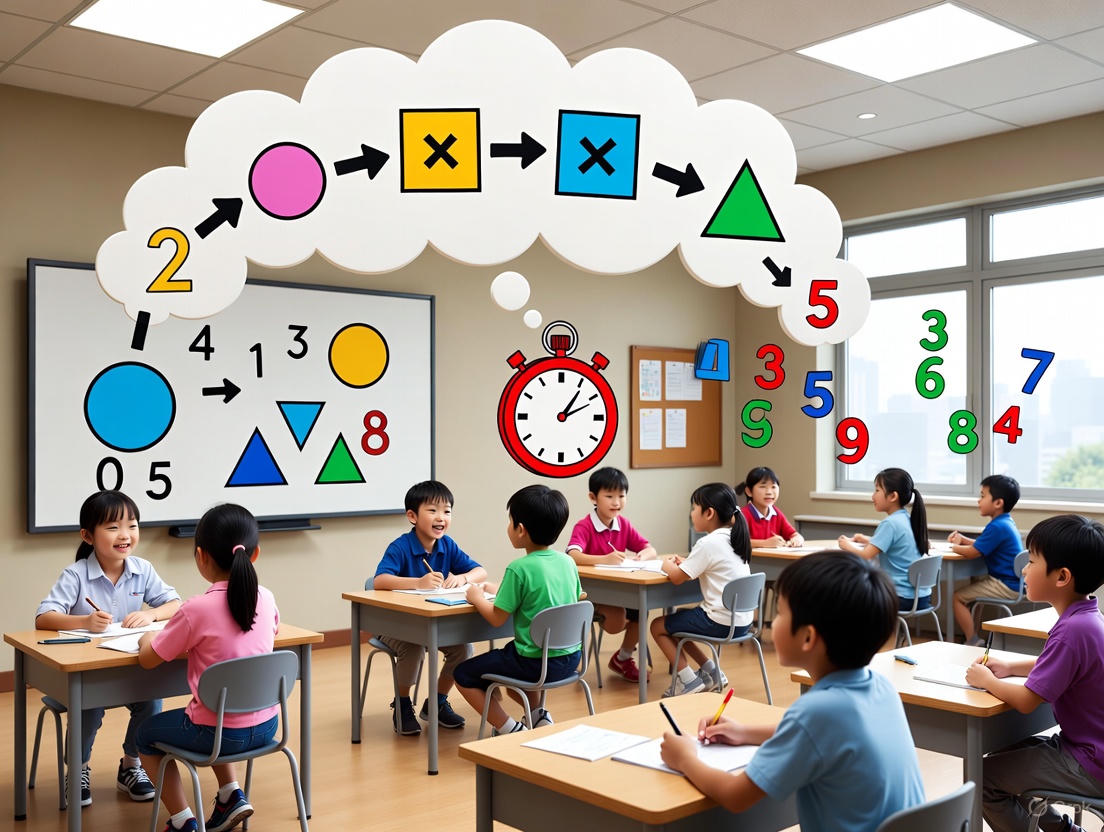
Here's a simple strategy:
This process of analyzing mistakes and identifying areas for improvement is how to excel in Singapore Secondary 4 Math. It's like detective work, uncovering the weaknesses and turning them into strengths.
Interesting Fact: Mock exams simulate the actual exam environment, helping students manage their time effectively and reduce stress during the real exam. Some schools even use past year exam questions from other schools to provide a more varied and challenging practice.
Let's be real, sometimes a little extra help can go a long way. Consider these tuition tips to help your child ace their Sec 4 Math exams:
Remember, parents, your support is crucial. Encourage your child, provide a conducive study environment, and celebrate their progress. With hard work, dedication, and a little bit of guidance, your child can definitely score in their Sec 4 Math exams!
Alright, parents and students! Let's talk about how to really ace that Sec 4 Math and figure out how to excel in singapore secondary 4 math. It's not just about memorizing formulas, you know? It's about unlocking doors to your future, especially with all this AI stuff popping up everywhere. Math is the language of the future, lah! And in Singapore, kiasu and kiasi is in our blood. So, let's make sure your child is well-equipped to tackle those exams and beyond.
Okay, first things first, let's break down what you're actually up against. The Sec 4 Math syllabus is chock-full of important concepts. It's not just about numbers; it's about problem-solving, critical thinking, and applying what you learn to real-world situations. Think of it as building a solid foundation for JC and beyond.
Key Topics Covered:
Why This Matters:
Listen up! A strong foundation in these areas isn't just about passing the exams. It's about developing the analytical and problem-solving skills that employers are desperate for. Whether your child dreams of being an engineer, a data scientist, or even a business leader, math is going to be their secret weapon. And with AI becoming more prevalent, understanding the math behind the algorithms is more important than ever.
Fun Fact: Did you know that the word "algebra" comes from the Arabic word "al-jabr," meaning "the reunion of broken parts"? Pretty cool, right? It highlights how math can bring seemingly disparate concepts together to solve complex problems.
Now, let's get down to the nitty-gritty. How do you actually master these key concepts? Here's where a strategic approach comes in handy.
Interesting Fact: The concept of zero, which is fundamental to modern mathematics, wasn't widely accepted in Europe until the 12th century! Before that, calculations were much more complicated. Imagine doing your Sec 4 Math without the number zero!

Okay, so you know what you need to learn. But how do you learn it effectively? That's where leveraging the right resources comes in.
1. The Power of Tuition:
2. Online Learning Platforms: Your Digital Toolkit:
3. Study Groups: Learning Together, Achieving Together:
Choosing the Right Resources:
History Tidbit: The first known use of the equals sign (=) was in 1557 by Robert Recorde, a Welsh mathematician. He chose it because, as he put it, "no two things can be more equal."
By strategically leveraging these resources, your child can not only conquer the Sec 4 Math syllabus but also develop the skills and confidence they need to succeed in their future endeavors. Don't say bo jio!
Alright, parents and students, listen up! Sec 4 Math is no joke, ah. It's the foundation for everything else, like your future career and even understanding how AI works (because, let's be real, AI is everywhere now). So, how to excel in Singapore Secondary 4 Math? It's not just about mugging; it's about having the right mindset and study habits. Let's dive in!
Think of the Sec 4 Math syllabus as your treasure map. You need to know where 'X' marks the spot, right? This syllabus isn't just a list of topics; it's a carefully crafted curriculum designed to build your mathematical prowess. Mastering it is key to scoring well in your exams and paving the way for future success.
Key Areas in a Nutshell:
Why is this stuff so important? Because math isn't just about numbers; it's about logical thinking, problem-solving, and analytical skills. These are the skills that employers really want, especially with all this AI stuff going on.
Okay, knowing the syllabus is one thing, but mastering the concepts? That's where the magic happens. Here's how to level up your understanding:
Fun Fact: Did you know that the concept of zero wasn't widely accepted in Europe until the 12th century? Imagine doing math without zero! Talk about a headache.
Exams are stressful, no doubt. But stress can be your friend, if you know how to manage it. Here's how to turn that exam anxiety into exam-slaying energy:
Interesting Fact: The word "mathematics" comes from the Greek word "máthēma," meaning "knowledge, study, learning." So, you're not just doing math; you're gaining knowledge!
This is the most important part, parents and students. A growth mindset means believing that your abilities can be developed through dedication and hard work. It's about seeing challenges as opportunities to learn and grow, not as roadblocks.
Remember, parents, your encouragement plays a huge role. Support your child's efforts, praise their progress, and help them believe in themselves.
History Tidbit: Ada Lovelace is considered the first computer programmer. She wrote an algorithm for a machine in the mid-1800s! Math and computers have been linked for a long time.
With the right mindset, effective study habits, and a whole lot of perseverance, your child can conquer Sec 4 Math and unlock a world of opportunities. Jiayou!